72° and Patchy rain nearby

Why You Should Vote for Andrea White


In this election, we have a choice between our experienced, incumbent Ohio House representative, Andrea White, who has championed mainstream policies fostering economic and job growth, affordability, public safety, assisting the needy and increased funding of public and private education, and her second-time challenger Rose Lounsbury, whose inexperience, polarizing partisan messaging, apparent unfamiliarity with core issues and controversial platform pose real concerns, including for our economy, affordability, healthcare and education.
In her six years representing us, Andrea White has supported the above priorities via legislation including: reduced taxes and regulations on businesses, bolstering economic and job growth and affordability; overhauling Ohio’s single-family homeowner’s tax credit and property tax exemptions to improve home affordability; supporting law enforcement and first responders; anti-crime measures such as legislation imposing tougher penalties, upgrading criminal background checks and combating vehicle thefts; increased funding of vocational and career training; and additional resources addressing Ohioans’ mental health needs (see generally, here). Andrea has worked across the aisle on bipartisan legislation, such as to combat infant mortality, assist low-income mothers and strengthen child support enforcement. She has repeatedly supported increased funding of both traditional public education and Ohio’s popular EdChoice voucher program for affordable access to private schools that can be life-changing for students in low-income families and failing school districts, and students whose public schools aren’t meeting their needs, most recently for her vote for Ohio House Bill 96 (see here and here).
Rose Lounsbury, while deservedly well-regarded, supports an agenda detrimental to Ohioans, and her inexperience is apparent in numerous inaccurate or misleading campaign statements that I doubt were intentionally false, but indicate a lack of understanding of key issues cloaked in boilerplate party talking points. As noted in my May 13th letter to the Oakwood Register editor (see sourced online version here), in one of her negative ads against Mrs. White and Ohio GOP leadership, she made outlandishly false claims that Ohio House Bill 249 would criminalize cross dressing and mainstream theatrical performances with cross-dressing characters, likely from her failure to either read the bill or to read it accurately, which are vital functions of a competent legislator.
In two other negative campaign ads (here and here), Rose falsely accused Mrs. White of voting to cut public education funding by diverting the funds to EdChoice vouchers via her vote for HB 96, when HB 96 actually increases Ohio’s K-12 public school funding by $226 million for the 2026-2027 budget versus the already record-high 2025 levels (see here and here). She has falsely claimed that Ohio Republicans have “continually cut funding to our public schools” (see here at 8:55), when funding of Ohio public schools on a per-pupil basis, from the state and overall, has been steadily increasing over the past 25 years (see here at page 10). She falsely claims EdChoice “drains” public school funding, when EdChoice doesn’t restrict Ohio’s budgeting levels for public schools, and EdChoice enrollments don’t withdraw funds that would otherwise cover public schools, including, as Rose claims (here at 8:25), by the fact that both being funded under the same budget line item. Ohio’s education budget includes funds for both public schools and EdChoice based on projected enrollment for each. Any leftover funds expire at the end of the budget cycle; they don’t go to public schools.
Rose blamed Republicans in Columbus for Ohio’s high property taxes and accused them of granting “tax cuts for the rich” at other Ohioans’ expense, when property taxes are driven mainly by local governments, mostly via voter-approved levies and bonds, have repeatedly given Oakwood among the highest property taxes of any municipality in the Dayton area. If she’s unhappy with her high property taxes, she has herself and other Oakwood voters to blame. The taxes controlled by the Ohio government are actually quite low, with among the 10 lowest income tax burdens of states charging income tax, including for the middle class (see here).
Mrs. Lounsbury’s platform presents serious concerns, particularly for our economy and affordability. Her campaign kickoff speech featured affordability as a reason voters should “flip” control of the Ohio House and government to Democrats, with logic exemplifying the correlation-causation fallacy: affordability (cost of living) has worsened for Ohioans in recent years, and Republicans are to blame since they controlled Ohio’s government during that same time period. She never mentioned prices and living costs also rose everywhere else nationwide, due to unprecedented deficit spending by the federal government financed with printed money, beginning with emergency COVID spending, but then continuing under the previous administration even as the pandemic waned. This brought inflation from only 1.4% in January 2021 to a staggering 40 year-high 9.1% in June 2022. This had nothing to do with Republicans in Columbus.
Rose is correct, though, that state government policies profoundly impact affordability. However, by equating a state’s cost of living with the political party controlling its government, she ironically makes one of the most powerful arguments against her entire candidacy. Blue states typically have significantly higher living costs, representing 9 of the top 10, and 16 of the top 20, states with highest costs of living, while red states represent 9 of the bottom 10, and 18 of the bottom 20, states with the lowest living costs, per 2025 rankings. If Rose thinks Ohio has an extraordinary affordability problem, she hasn’t looked at the data; Ohio’s cost of living is not only below most states, it’s lower than every blue state in America excluding New Mexico, which is ranked right behind Ohio. In other words, affordability is worse than Ohio’s in virtually every state with Democrats in control, as she is advocating.
This isn’t merely a correlation; it’s a result of blue state policies, including those in Mrs. Lounsbury’s platform. Blue states impose significantly higher taxes and regulations on individuals and businesses. This leaves residents with less after-tax income for affordable living, and drives up operating costs on businesses, who respond either by reducing or eliminating hiring, staffing or pay increases to offset those costs (thus hampering affordability for the workforce), or by transferring those costs to customers via higher prices. This is why things are often more expensive in blue states than red states.
Blue states account for all of the 10 states with the highest income taxes, and none of the 10 with the lowest among states that charge income tax (see here). Presumably, Rose supports raising income taxes given her “tax cuts for the rich” rhetoric, and even limiting tax increases to “the wealthy” is a job killer and inflates consumer prices from its impact on businesses. This is because 95% of all businesses pay income taxes through their owners’ individual income tax returns and tax rates (aka “flow-through” taxation), and 91% of all taxable income from these “flow-through” businesses – the backbone of our economy and job creation – is reported in the top 20% income level and 57% is reported in the top 1% level (see here).
Blue states impose higher regulations detrimental to affordability, including zoning and permitting laws that elevate housing costs, and labor laws such as raising the minimum wage, which has consistently inflated consumer prices and reduced jobs while crushing small businesses (see, e.g., here and here). Mrs. Lounsbury supports the latter with her website’s “living wage” rhetoric.
Like most blue states, Mrs. Lounsbury supports expanding unions, which impose an average of 15% – 25% higher labor costs by coercing employers to provide above-market compensation and benefits packages, including pensions that are unaffordable to most private companies and a leading cause of state budget deficits (see here at p. 7). This results in higher consumer prices and job losses. A unionized can hardly provide competitively-priced products if its labor costs are up to 30% higher than its non-unionized competitors. Unsurprisingly, private sector union membership has therefore plummeted by over 70% since 1980 and is now five times more prevalent among government employees, whose employers can force taxpayers to pay the inflated labor costs. A 2018 Ohio State University study found that one of the two main causes of Ohio’s loss of manufacturing fueling its over 50-year economic decline was effectively labor unions; specifically, manufacturers relocating to other states with “right to work” laws that prohibit requiring workers to join unions.
Rose has an entire webpage promoting unions, and while she cites her personal and family history of union membership, don’t think that’s the only reason. Her 2024 and 2026 campaign finance disclosures show multiple unions lining her campaign’s pockets. Therefore, if you vote for Rose Lounsbury, you are voting to double-down on a leading cause of Ohio’s manufacturing and economic decline, for the enrichment of her union donors. A key step to revitalizing Ohio’s economy is actually the opposite of Rose’s agenda: make Ohio a “right to work” state so we can bring back those lost manufacturing jobs.
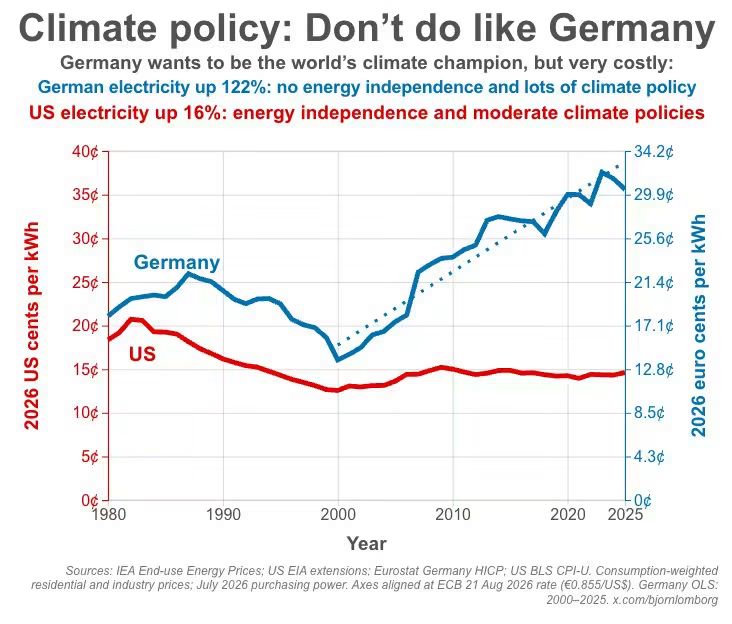
As with many blue states, Mrs. Lounsbury supports burdensome environmental regulations that inflate business operating costs and prices, including “cap-and-trade” initiatives that heavily tax and regulate fossil fuels to compel transitions to costly, inefficient and unreliable “green” energy such as wind and solar power, which her website ironically presents as making energy “affordable” as families struggle with high energy costs. In Germany, these policies increased consumer energy prices by over 120% to the highest in Europe and among the highest in the world (see here, here and here), with energy shortages in winter. Washington State’s similar program inflated energy prices by 41% in five years, and California’s program increased energy prices five times higher than anywhere else in the U.S. for a staggering 127% price increase, with periodic energy shortages. If you’d like your energy bills to balloon by 40% to 127% with possible shortages, then Rose Lounsbury is your candidate. While her campaign’s “Working Families” webpage laments high energy costs for families, her “Environment” webpage pushes these same energy policies. Further, that webpage suggests she supports restricting or banning fracking and other fossil fuel production, which would devastate eastern Ohio’s economy.
Similarly, Mrs. Lounsbury’s “Healthcare” webpage laments higher healthcare costs for families while prescribing policies that would drive them higher. Her proposal to mandate minimum staffing levels for healthcare facilities – likely higher than they would otherwise maintain – would trigger higher operating costs passed onto patients. Alternatively, facilities may resort to hiring staff willing to work for substandard compensation to satisfy the mandate, risking inferior healthcare, sanitation and overall patient experience.
Mrs. Lounsbury’s education agenda would produce poorer student outcomes and fewer educational choices, leaving many students trapped in schools that are failing or otherwise not meeting their needs. Her flawed education pitch blames sheer Republican control of Ohio’s government for Ohio supposedly ranking 30th in education (see here at 13:40) (it’s 12th per a July 2026 Ohio Capital Journal report), while falsely claiming Republicans have cut education funding (see here at 13:00) when the state’s funding of its public education has steadily risen over the past 25 years (see here at page 10). As with property taxes, she ignores the central role of local government. Ohio would rank significantly higher but for pockets of failing school districts with mismanaged municipal governments (e.g., Dayton, Toledo, Cincinnati, Cleveland, Columbus), and like most others in the U.S., the vast majority have been run by liberal Democrats and their teachers’ union donors for decades. A recent Progressive Policy Institute study found blue states with heavy teachers’ union influence frequently have worse student literacy than red states. Only 4 of 23 states with the highest scores were blue states (13 were red states), and 8 of the 10 states with the worst literacy scores were blue states with heavy teachers’ union influence. Teachers’ unions notoriously oppose any manner of education reform, accountability and school choice because they prioritize their self-interests over students. This hardly makes the case for “flipping” the Ohio House and government to Democrat control.
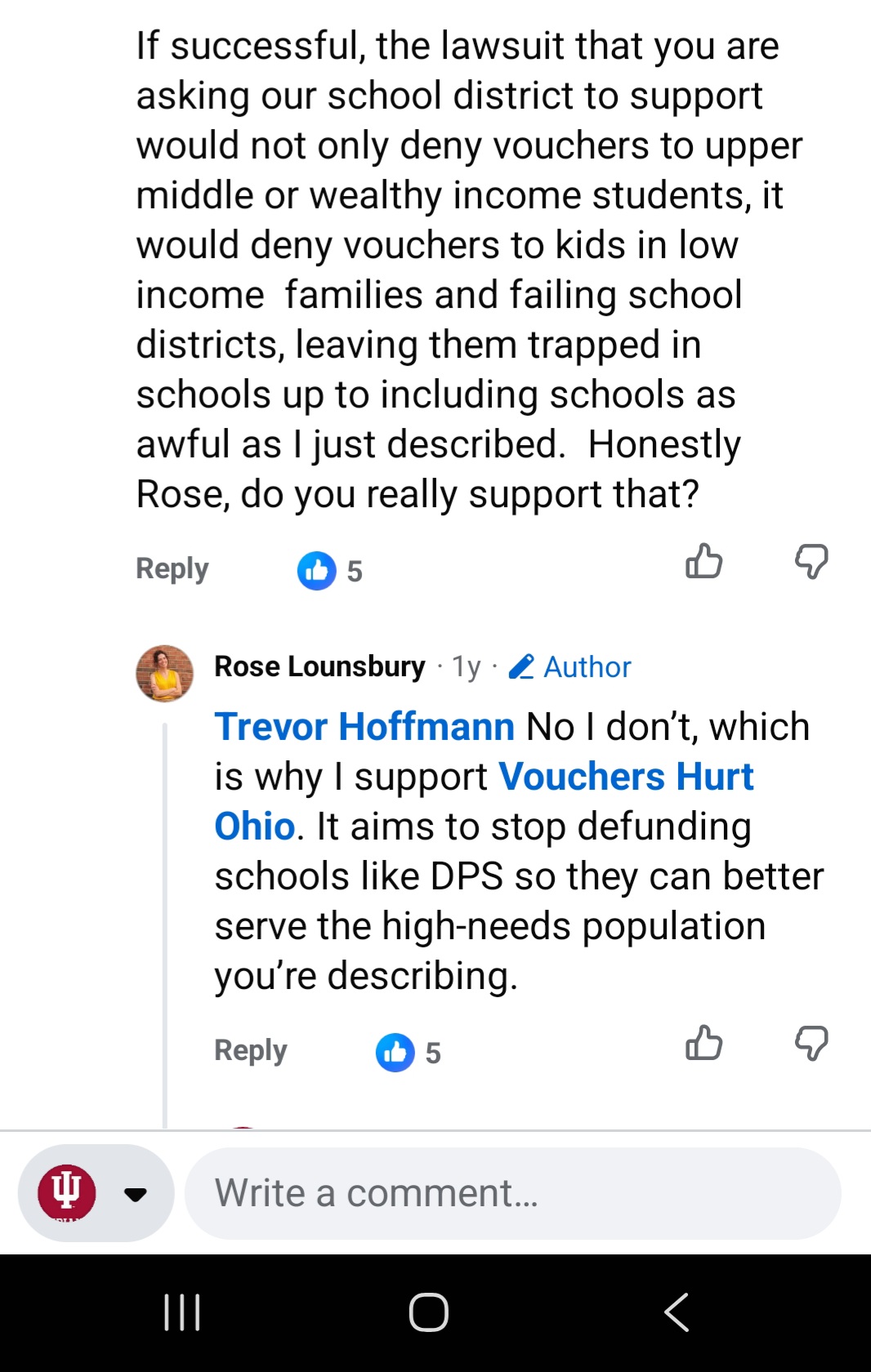
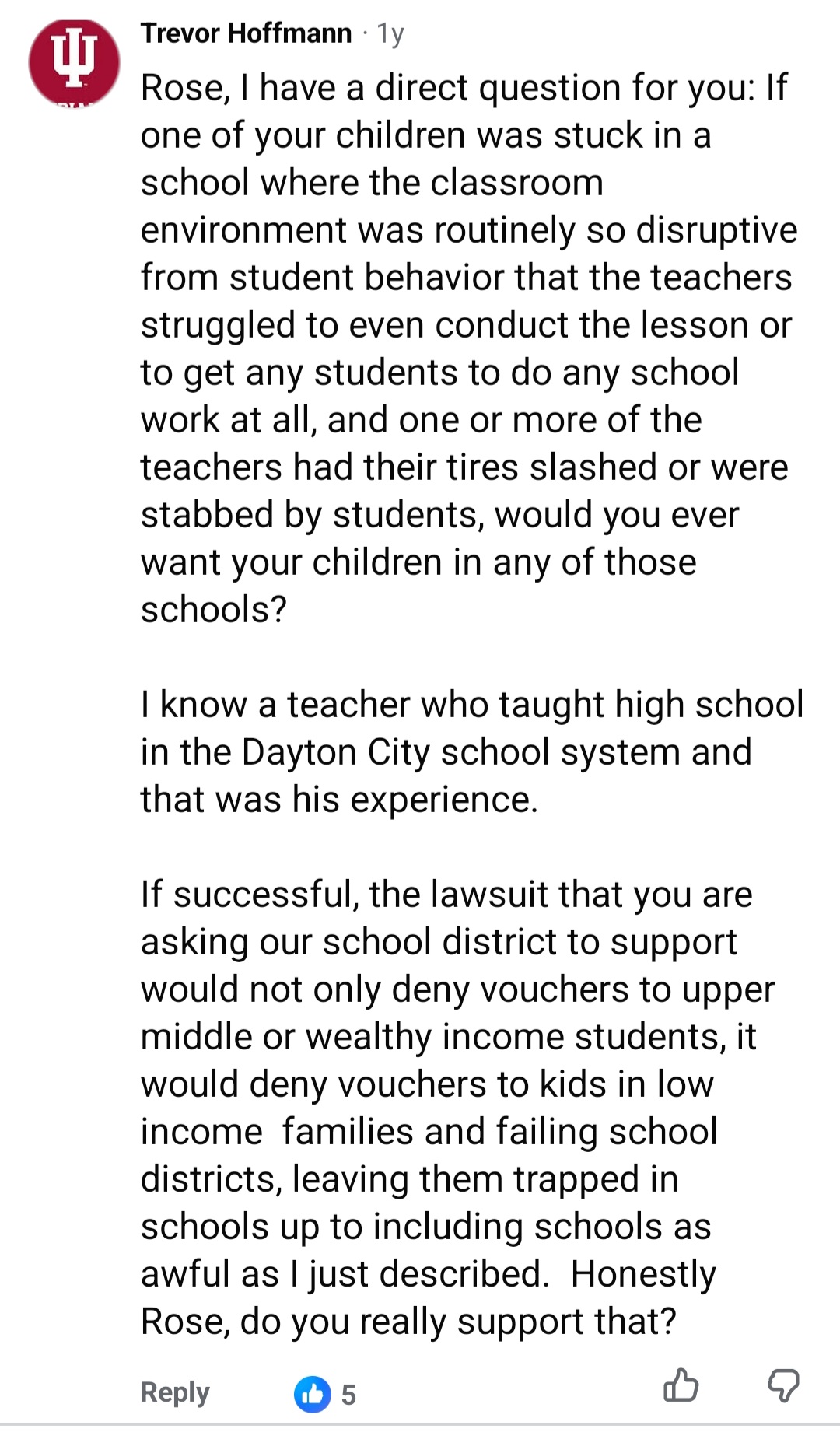
As a far-left Democrat and former teachers’ union representative, Rose Lounsbury would tow the line on policies that have perpetuated these pockets of failing districts and left their students without viable alternatives. Unsurprisingly, she vigorously supports eliminating Ohio’s entire EdChoice voucher program (not just the 2023 expansion). This would leave disadvantaged students trapped in troubled districts and learning environments that in the case of the Dayton Public Schools (DPS) district, Rose admitted to me she wouldn’t want to leave kids trapped in (presumably including her own), given the disturbing conditions there as described by a former DPS teacher. She purportedly champions education, while seeking to deny disadvantaged students access to high-quality education such as her kids enjoy in Oakwood’s top-ranked district. I find this hypocritical.
Lastly, the abrasive, partisan tone of Mrs. Lounsbury’s campaign messaging with its continuous negative attacks against Mrs. White and other Ohio Republicans indicate that if elected, she will not work effectively across the aisle with the likely continuing Republican House majority to actually get things done. Rather, she will be a shrill, ineffectual performer, posturing from the margins of the House without delivering meaningful results for her constituents.
For these and many other reasons, I am voting for the candidate with years of experience successfully representing us that Mrs. Lounsbury lacks, and whose policies are grounded in a proven history of better affordability and opportunities for Ohioans. She is also the candidate who has shown herself to be the adult in the room in this race. I am voting for Andrea White, and if you are concerned about Ohio’s future, I urge you to do the same.