52° and Clear

Correcting Rose Lounsbury's Education Misinformation


Correcting Rose Lounsbury’s Education Misinformation
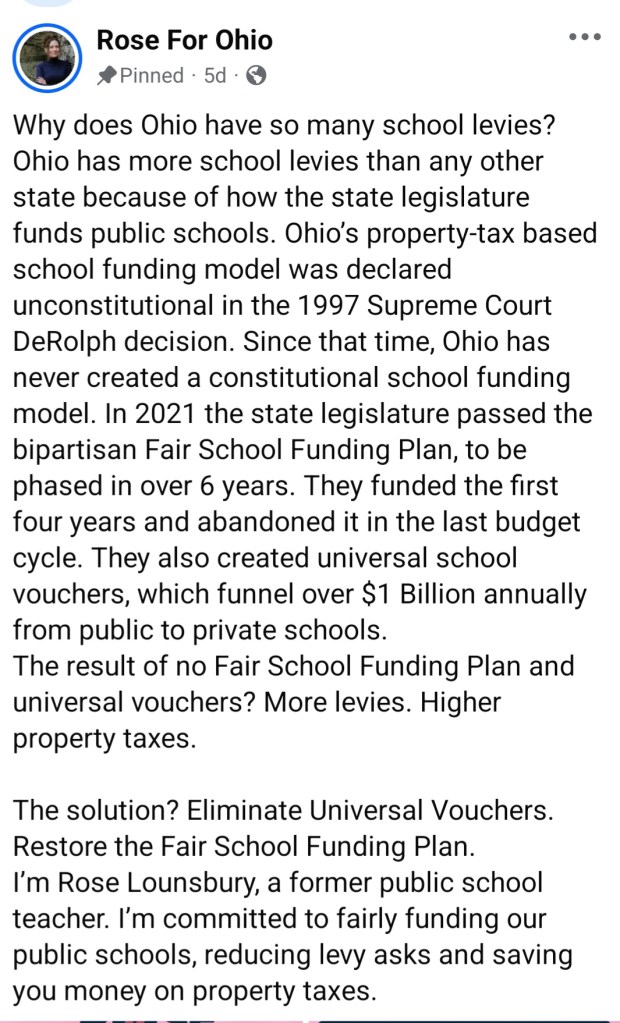
In her campaign social media posts, website and speeches, Ohio House District 36 candidate Rose Lounsbury has made a number of false or misleading statements regarding the Ohio state government’s funding of public education, and of Ohio’s popular EdChoice voucher program. Assuming this was unintentional on her part, they represent, at a minimum, a lack of proper understanding of public education funding and of the EdChoice program.
The following is the most recent example:
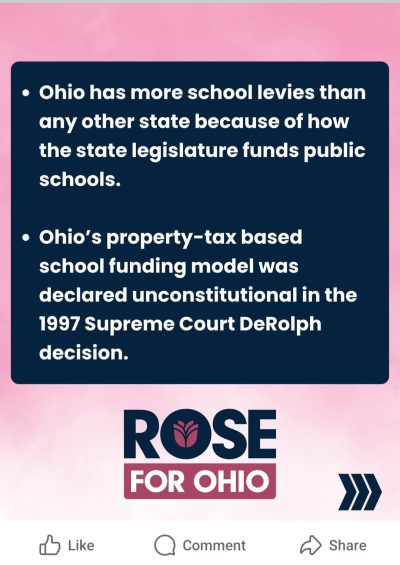
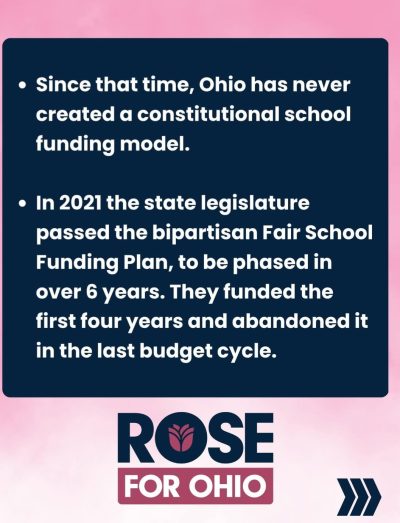
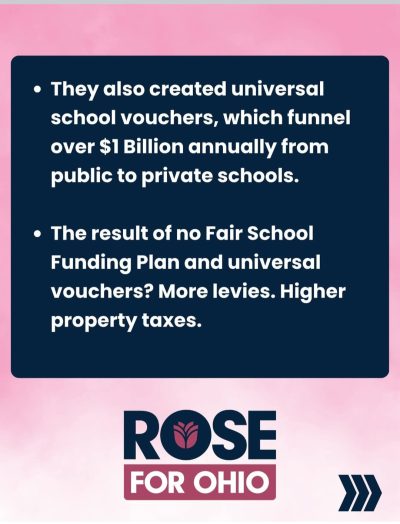
Here are the key facts and resources you need to know:
- The state has NOT been cutting public school funding, such as to channel it to vouchers.
Rose’s above post implies the state has been cutting its public education funding. She also falsely claimed that Ohio Republicans have “continually cut funding to our public schools” (see here at 8:55). The reality is that the state’s funding of its public schools on a per-pupil basis, and adjusted for inflation, has steadily increased over the past 25 years both before and since the creation of EdChoice and other voucher programs. See this State Auditor’s report on school revenues here at its pages 9 and 10 for more information on that. In two other negative campaign ads (here and here), Rose falsely accused her election opponent, incumbent Ohio House Representative Andrea White, of voting to cut public education funding by diverting the funds to EdChoice vouchers via her vote for HB 96. To the contrary, HB 96 increases Ohio’s K-12 public school funding by $226 million for the 2026-2027 budget versus the already record-high 2025 levels (see here and here).
For in-depth analysis debunking these and other false claims about Ohio’s public school funding and how it is impacted by EdChoice vouchers, see the outstanding research articles published by the Thomas B. Fordham’s Institute here in Dayton, starting with this one: Don’t Blame EdChoice for District Budget Woes. This article notes that Ohio public school enrollment is down 15% since 2010 which reduces (the nevertheless increased) state funding from what it would otherwise be, since enrollment numbers are a factor under the state’s funding formula. However, rather than reducing staffing accordingly, school districts only reduced their teacher staffing by 5% and actually increased administrative staffing by 3% during that same time period. This article also points out that Ohio public school districts actually received nearly $1 billion more funding for 2026 than they had projected in a spring 2022 five year budgetary forecast, which was made prior to the 2023 EdChoice expansion. Therefore, EdChoice is not the cause of Ohio public schools’ budgetary challenges, it’s quite plausibly inadequate financial management and cost control to a significant extent.
- The state has NOT been disregarding the funding changes required by the DeRolph v. State decision.
The DeRolph decision held the state’s then funding formula unconstitutional, based significantly on the formula’s primary reliance on local taxes for funding. Since 2022, the state has been phasing in the Fair School Funding Plan (FSFP), a bipartisan plan enacted precisely to comply with the requirements of the DeRolph decision. That plan shifts most funding to sources other than local taxes, with more funding from the state. The FSFP creates a more equitable distribution of state funding as well, based on a number of factors including property values and income levels of districts, and their actual costs and expenses of educating kids. Also, the Ohio government did NOT abandon that plan last year, it has continued phasing it in to the present day. See here. For sure, Democrats and Republicans disagree on whether the FSFP funding can and should be phased in more rapidly and on the adequacy of public education funding overall (Democrats will always favor higher spending), but it is not true that the Republican-led Ohio legislature or Governor have abandoned the FSFP.
Regarding the ongoing lawsuit seeking to eliminate the EdChoice Program, see these Fordham Institute articles here and here for further critiques of the lawsuit, and decision of the lower court, on the state’s public school funding and how it is impacted by EdChoice.
- It is NOT true that school districts across Ohio have all had to pass numerous levies to compensate for insufficient state funding.
Rose may have a skewed perception on this from her unusual experience as an Oakwood resident. Ohio’s districts vary widely on the state funding they receive, and on the number and size of levies they pass. The latter is partially due to the former, and to differences in voter preferences. The Fair School Funding Plan varies state funding based in part on property values and income levels of a given district as a form of “equity”: poorer districts that lack the income and property values to carry as much of the funding load receive more state funding, while wealthy districts such as Rose’s in Oakwood receive less funding, since they are better able to “pay their fair share” of the funding burden. This is why, for instance, the relatively poor Dayton Public Schools district had, on a per-pupil basis, 19.6% more funding and 25% higher spending (just outside the top 5% highest of all Ohio districts) than Oakwood in 2025, despite having passed only ONE levy in the past 15 years. Further, Oakwood residents are more willing to pass more levies, whether needed or not, because they place a high priority on their prized, top-ranked schools, which are the community’s flagship attraction, and Oakwood’s voter turnout also leans heavily Democratic by 60-65%, thus favoring higher levels of government and school spending. If Rose is upset with her high property taxes from these levies, she has herself and other liberal Oakwood voters to blame. See this chart for the 2025 school funding and spending data.
- Public school funding is NOT being “channeled” to, or “drained” by, EdChoice and other voucher programs.
Rose Lounsbury falsely claims EdChoice “drains” public school funding, when EdChoice doesn’t restrict Ohio’s budgeting levels for public schools. EdChoice enrollments don’t withdraw funds that would otherwise cover public schools, including, as Rose claims (here at 8:25), by the sheer fact that both are funded under the same Education budget line item. Ohio’s education budget line item includes funds for both public schools and EdChoice based on projected enrollment for each during the biennial budget cycle. Any leftover funds expire at the end of the budget cycle; they don’t go to public schools.
Further nothing in EdChoice’s design limits the amount the state can budget for public schools; the state and budget as much as it wishes for public schools. The most Rose can do is speculate that if these vouchers did not exist, state might have budgeted even more increased funding for public schools, but that is pure conjecture. There is no withdrawal of money to EdChoice that somehow belonged to or was allocated to public schools.
Again, see this and other Fordham Institute articles for analysis debunking these and other false claims about Ohio’s public school funding and how it is impacted by EdChoice vouchers: Don’t Blame EdChoice for District Budget Woes.
- Eliminating vouchers would NOT significantly increase public school funding, even if all of the funding for the former were allocated to the latter, which is unlikely to happen.
The $1.09 billion the state budgeted for EdChoice for 2025 sounds like a large number, but that equals only 8.1% of the $13.51 billion the state budgeted for K-12 public schools in 2025. See here. A mere 8.1% increase in state funding of public schools would be a negligible funding increase, on a per pupil basis and if it were actually needed, the state could simply budget more for public schools without compromising EdChoice.
For example, for the academically struggling Dayton Public Schools district (DPS), if EdChoice had been eliminated and the money spent on it that year was instead allocated to an 8.1% increase in State public school funding, that would have only yielded an additional $919 in per-student spending for the DPS district (i.e., $11,343 state funding per pupil increased by 8.1%) See here for this funding data. In 2024, among that district’s 8th graders, only 8.9% were proficient in math and only 11.5% were proficient in English language arts, and the four-year high school graduation rate was only 72.3%. That is despite $23,209 in total spending that year, do we really think another $919 per student, plus a small increase in State funding from enrollment of returning former EdChoice students, would have been the transformative catalyst that would have significantly improved those outcomes?
For further information, see this article on this page, refuting Rose’s prior claims that eliminating EdChoice vouchers and allocating those funds to public schools would somehow improve failing school districts in Ohio. Higher levels of spending have not produced better outcomes, as seen by the dismaying student performance results in some of the highest-spending districts (Dayton, East Cleveland, or Baltimore City for an out-of-state example) versus those of Oakwood City Schools.
Share this: